AUTOMOTIVE ENGINEERING JOURNAL · POWERTRAIN TECHNOLOGY
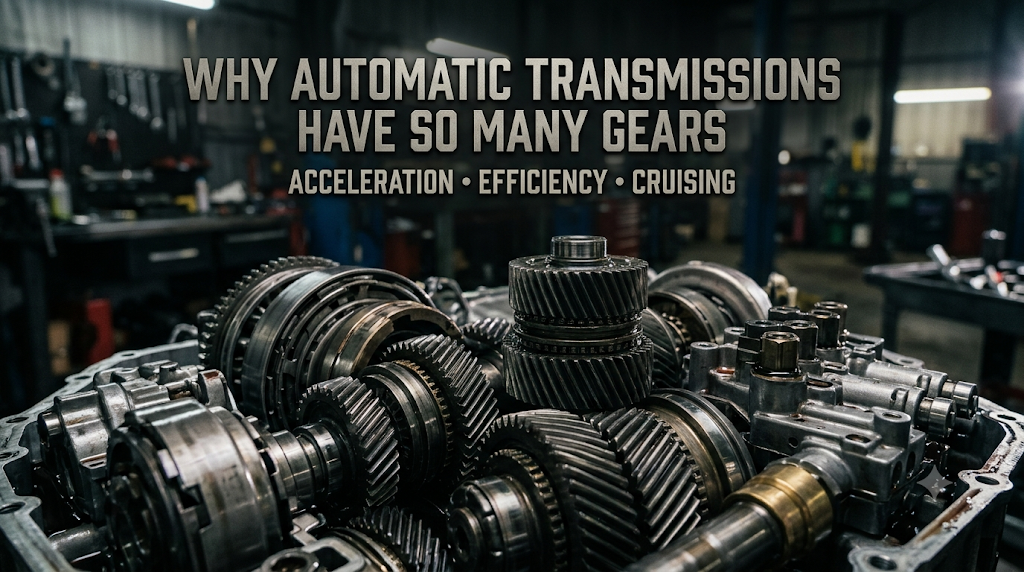
More Gears. Smarter Power Delivery.
Discover why modern automatic transmissions use six, eight, nine, or even ten forward gears—and how those extra ratios influence acceleration, engine speed, and fuel efficiency.
Not long ago, many passenger cars used automatic transmissions with only three or four forward gears.
Today, six-speed, eight-speed, nine-speed, and ten-speed automatic transmissions are common across different vehicle categories.
Some drivers may wonder why a car needs so many gears when older vehicles managed with far fewer.
The answer involves a careful balance between acceleration, engine efficiency, driving comfort, and highway cruising.
An engine does not produce the same torque or operate at the same efficiency at every speed.
A transmission helps match the engine’s operating characteristics to the speed and power demands of the vehicle.
Adding more gear ratios gives engineers additional choices for keeping the engine in a useful operating range.
Modern multi-speed transmissions are designed to deliver strong performance at low speeds while reducing unnecessary engine speed during steady cruising.
Understanding how this works begins with the basic purpose of gears.
What Does a Transmission Actually Do?
A vehicle’s engine produces rotating force, called torque.
That torque must reach the wheels to move the vehicle.
However, the engine and wheels operate at very different rotational speeds.
When a car starts moving, its wheels turn slowly.
At highway speeds, the wheels rotate much faster.
A transmission provides different mechanical ratios between engine speed and wheel speed.
These ratios allow the engine to operate effectively across a wide range of driving conditions.
Low gears multiply torque at the wheels, helping the vehicle accelerate from a stop.
Higher gears reduce engine speed relative to road speed, which can improve cruising efficiency.
The transmission therefore acts as an adjustable connection between the engine and the driven wheels.
TRANSMISSION BASICS / TWO MAIN JOBS
Provide greater torque multiplication to help with starting, climbing, towing, and acceleration.
Allow the wheels to turn relatively quickly while the engine operates at a lower rotational speed.
Understanding Gear Ratios in Simple Terms
A gear ratio describes the relationship between rotational speeds at the transmission’s input and output.
For example, a 4:1 gear ratio means the transmission input rotates four times for every one rotation of its output.
Ignoring mechanical losses, this ratio also multiplies output torque by approximately four.
That makes a low gear useful when a vehicle needs strong pulling force.
A ratio closer to 1:1 provides less torque multiplication.
An overdrive ratio below 1:1 allows the transmission output to rotate faster than its input.
This can reduce engine RPM during highway cruising.
The actual relationship between engine speed and wheel speed also depends on the final-drive ratio, tire size, and torque-converter behavior.
A Simple Gear Ratio Example
Imagine a transmission with a first-gear ratio of 4.5:1.
In that gear, the transmission provides substantial torque multiplication.
Now imagine its highest gear has a ratio of 0.65:1.
That overdrive ratio allows the vehicle to maintain a given road speed with fewer engine revolutions than would be required in a direct 1:1 gear.
These figures are illustrative rather than specifications for a particular vehicle.
ENGINEERING PRINCIPLE
Low Gears Favor Wheel Torque. High Gears Favor Lower Engine Speed.
The transmission changes the balance between rotational speed and torque to suit the vehicle’s driving conditions.
Why More Gears Improve Acceleration
Acceleration depends on how effectively the powertrain delivers force to the wheels.
Engines produce different amounts of torque and power at different RPM levels.
When a transmission shifts into the next gear, engine speed usually drops.
If the gap between two gears is large, the engine may fall well below its most useful power range.
A transmission with more ratios can use smaller steps between gears.
This helps keep engine speed closer to the range where strong acceleration is available.
For example, a performance-oriented transmission may select closely spaced intermediate gears to maintain engine output during rapid acceleration.
More gears do not automatically make a vehicle faster.
Acceleration also depends on engine power, vehicle mass, traction, shift speed, and transmission calibration.
However, well-chosen gear ratios can help the engine use its available performance more effectively.
Why More Gears Can Improve Fuel Efficiency
Fuel efficiency depends partly on the engine’s operating speed and load.
Internal-combustion engines have operating regions where they convert fuel energy into useful mechanical work more efficiently.
A transmission with several ratios can provide more opportunities to operate near those regions.
During gentle acceleration, the transmission may shift earlier to reduce engine RPM.
During hill climbing or rapid acceleration, it may select a lower gear to provide more power.
At steady highway speeds, a high overdrive gear can reduce engine speed.
Lower RPM may reduce certain frictional and pumping losses, although the overall efficiency benefit depends on engine load and design.
Modern automatic transmissions also use sophisticated electronic controls to decide when to shift.
These systems consider vehicle speed, accelerator position, engine demand, and other operating conditions.
The result can be better coordination between engine operation and driving requirements.
Why Highway Cruising Needs Different Gears
Starting from a stop requires substantial wheel torque.
Maintaining a steady speed on a level highway usually requires much less wheel torque than accelerating rapidly.
This creates an opportunity to use a taller gear ratio.
In a high gear, the engine can rotate more slowly while the wheels continue turning at the required road speed.
Lower engine speed can reduce noise and improve fuel economy under suitable conditions.
It can also make highway driving feel more relaxed.
However, extremely low engine speed is not always efficient or desirable.
If the engine must work too hard at low RPM, the transmission may downshift.
This helps avoid operating conditions where the engine cannot deliver the required torque smoothly or efficiently.
HIGHWAY CRUISING / ILLUSTRATIVE COMPARISON
Same Road Speed. Different Engine RPM.
The engine may rotate faster at the same vehicle speed.
The engine may rotate more slowly, reducing noise and potentially improving efficiency.
Actual RPM depends on gear ratios, final drive, tire size, and operating conditions.
How Automatic Transmissions Evolved from Four to Ten Speeds
Older automatic transmissions commonly used three or four forward gears.
These designs provided useful performance but had relatively large gaps between ratios.
As engine technology and fuel-economy requirements evolved, manufacturers introduced transmissions with more speeds.
Five- and six-speed automatics became common in many vehicle segments.
Later designs expanded to eight, nine, and ten forward gears.
Additional ratios allowed engineers to combine a low first gear with high overdrive gears while maintaining smaller steps between intermediate ratios.
Advances in transmission controls, clutch technology, hydraulic systems, and compact gear arrangements made these designs practical.
However, not every vehicle needs the maximum possible number of gears.
The ideal transmission depends on engine characteristics, vehicle purpose, packaging constraints, and cost.
What Happens Inside a Modern Automatic Transmission?
Many conventional automatic transmissions use planetary gearsets.
A planetary gearset typically contains a central sun gear, surrounding planet gears, a planet carrier, and an outer ring gear.
Different speed ratios can be produced by connecting or holding different members of the gearset.
Automatic transmissions use clutches and sometimes brakes to control these connections.
Combining multiple planetary gearsets creates a range of forward ratios and reverse.
Electronic controls coordinate the engagement and release of internal clutches.
Hydraulic pressure is commonly used to operate these components.
Modern engineering allows many gear ratios to fit inside a relatively compact transmission housing.
However, more gears generally increase the importance of precise control and careful mechanical design.
What Does the Torque Converter Do?
Many conventional automatic transmissions use a torque converter between the engine and transmission.
A torque converter transfers engine power through fluid movement.
It allows the engine to continue running while the vehicle is stationary and the transmission remains engaged.
During initial acceleration, the torque converter can also provide torque multiplication under certain operating conditions.
However, fluid coupling can introduce energy losses.
Modern torque converters often include lockup clutches.
When appropriate, the lockup clutch creates a more direct mechanical connection between the engine and transmission.
This reduces slip and can improve efficiency.
Some modern automatics use different starting or clutch arrangements, so torque-converter operation is not identical across every transmission design.
Why Transmission Software Matters as Much as Gear Count
A transmission with many ratios is only useful if it selects them intelligently.
Modern automatic transmissions rely on electronic control systems.
These systems monitor factors such as accelerator input, vehicle speed, engine torque demand, and operating temperature.
They determine when to upshift, downshift, or hold the current gear.
During gentle driving, the system may prioritize efficiency.
During aggressive acceleration, it may hold lower gears longer.
When climbing a hill, the transmission may select a lower gear to maintain adequate power.
Some vehicles also offer different driving modes.
Sport modes may favor quicker response and higher engine speeds.
Economy modes may prioritize earlier upshifts and lower RPM.
Good calibration helps prevent unnecessary shifting while balancing performance, comfort, and efficiency.
Can Too Many Gears Cause Problems?
Adding gears creates engineering benefits, but it also introduces tradeoffs.
More complex transmissions may require additional clutches, hydraulic controls, and sophisticated software.
Packaging the components into a limited space can be challenging.
Transmission weight, manufacturing cost, friction, and maintenance requirements must also be considered.
Some vehicles may shift frequently when driving conditions change.
This behavior is sometimes called gear hunting.
It can occur when the control system repeatedly moves between nearby ratios.
Careful calibration helps reduce unnecessary shifting.
Manufacturers must balance the theoretical benefits of additional gears against the practical complexity of the transmission.
Beyond a certain point, the benefit of adding another ratio may be relatively small.
Six-Speed vs. Eight-Speed vs. Ten-Speed Automatic Transmissions
The number of gears influences transmission flexibility, but it does not determine overall quality.
A well-designed six-speed transmission may perform better in a particular vehicle than a poorly matched transmission with more ratios.
Still, different gear counts offer useful general characteristics.
| Transmission | Potential Advantage | Main Consideration |
|---|---|---|
| 4-Speed Automatic | Relatively simple ratio selection | Larger gaps between gears |
| 6-Speed Automatic | Useful balance of ratio coverage and complexity | Fewer intermediate ratios than newer designs |
| 8-Speed Automatic | Closer ratio spacing and flexible cruising options | More complex design and control |
| 10-Speed Automatic | Many choices for matching engine speed to demand | Requires sophisticated shift management |
Automatic Transmission vs. CVT: Why the Difference Matters
A continuously variable transmission, or CVT, approaches the problem differently.
Instead of using a fixed set of traditional gear ratios, many CVTs provide a continuously adjustable ratio within their operating range.
This allows the engine to remain near a selected operating speed while vehicle speed changes.
Some CVTs use pulleys connected by a belt or chain.
Other continuously variable designs use different mechanisms.
A conventional multi-speed automatic selects among discrete ratios.
A CVT changes its ratio more continuously.
Both approaches aim to match engine operation to driving conditions.
However, their driving feel, mechanical design, and efficiency characteristics can differ.
Some CVTs also simulate stepped gear changes to create a more familiar driving experience.
Why Electric Vehicles Usually Need Fewer Gears
Electric vehicles provide an interesting comparison.
Electric motors generally deliver useful torque across a broad operating range.
They can also operate efficiently over a wide range of rotational speeds.
As a result, many battery-electric vehicles use a single-speed reduction gearbox.
This simplifies the drivetrain and reduces the need for frequent ratio changes.
However, some electric vehicles use multi-speed transmissions to improve performance or meet specific design goals.
The difference highlights why conventional internal-combustion engines benefit from multiple gears.
Their torque and efficiency characteristics make ratio selection especially important.
How Gear Count Affects Everyday Driving
Drivers may notice the effects of a multi-speed automatic in several situations.
When accelerating from a traffic light, a low first gear can help the vehicle move confidently.
During moderate acceleration, closely spaced gears may keep engine response smooth.
On a highway, an overdrive gear can reduce engine RPM.
When passing another vehicle, the transmission may downshift to increase available wheel torque and engine power.
When climbing a steep grade, it may hold a lower gear to maintain performance.
These changes happen automatically, often without the driver needing to think about them.
The goal is to make the vehicle responsive when power is needed and efficient when driving demands are lower.
POWERTRAIN RESPONSE / EVERYDAY DRIVING
A low gear provides substantial torque multiplication.
Intermediate gears help maintain useful engine speed.
A high gear can lower engine RPM and reduce noise.
The transmission downshifts when additional power is required.
Does More Gears Always Mean Better Fuel Economy?
No.
Additional ratios can create opportunities for more efficient engine operation, but the final result depends on the entire powertrain.
Engine design, vehicle weight, aerodynamics, tire characteristics, transmission losses, and software calibration all affect fuel consumption.
A transmission with more gears may also introduce additional internal friction or mechanical complexity.
Engineers therefore evaluate the complete system rather than assuming that the highest gear count automatically delivers the best results.
The most effective transmission is the one that provides an appropriate range of ratios with good efficiency, durability, and drivability.
Frequently Asked Questions
Why do modern automatic transmissions have eight or ten gears?
Additional ratios help engines operate at useful speeds during acceleration and at lower RPM during cruising, potentially improving performance and efficiency.
Does a ten-speed automatic accelerate faster than a six-speed?
Not necessarily. Acceleration depends on engine output, gear ratios, vehicle weight, traction, shift speed, and calibration.
What is an overdrive gear?
An overdrive gear has a transmission ratio below 1:1, allowing the transmission output to rotate faster than the input.
Why does an automatic transmission downshift when accelerating?
Downshifting increases torque multiplication and often raises engine RPM into a range where more power is available.
Do more gears reduce engine wear?
Lower cruising RPM may reduce some operating stresses, but overall engine wear depends on lubrication, temperature, load, maintenance, and engine design.
Why do electric cars often have only one gear?
Electric motors typically provide useful torque over a broad speed range, reducing the need for multiple transmission ratios.
Is a CVT better than a conventional automatic?
Neither is universally better. Their advantages depend on vehicle design, efficiency goals, driving characteristics, and durability requirements.
Final Thoughts
Modern automatic transmissions use more gears because engines operate differently across their speed ranges.
Low gears provide torque multiplication for starting and acceleration.
Intermediate gears help keep engine speed within useful operating ranges.
High gears reduce engine RPM during steady cruising.
Additional ratios allow engineers to combine these advantages while reducing large gaps between gear changes.
However, gear count is only one part of transmission design.
Mechanical efficiency, electronic controls, shift quality, and vehicle requirements are equally important.
A well-engineered automatic transmission balances acceleration, fuel economy, smoothness, and durability.
That is why the move from four-speed to eight- and ten-speed automatics represents more than simply adding extra gears.
It reflects a broader effort to make internal-combustion vehicles more responsive and efficient across a wider range of driving conditions.

Lead Automotive Research Engineer, Master ASE Certified Diagnostic Specialist, and powertrain dynamics consultant with over 18 years of experience in internal combustion thermodynamics, electric vehicle architectures, and chassis control systems.