AUTOMOTIVE ENGINEERING / VEHICLE SAFETY SYSTEMS
The Science Behind Anti-Lock Braking
Understand how modern vehicles detect wheel lockup, regulate braking pressure, and help drivers maintain steering control during emergency stops.
Imagine driving on a wet road when a vehicle suddenly stops ahead of you.
You press the brake pedal firmly, expecting the car to slow down as quickly as possible.
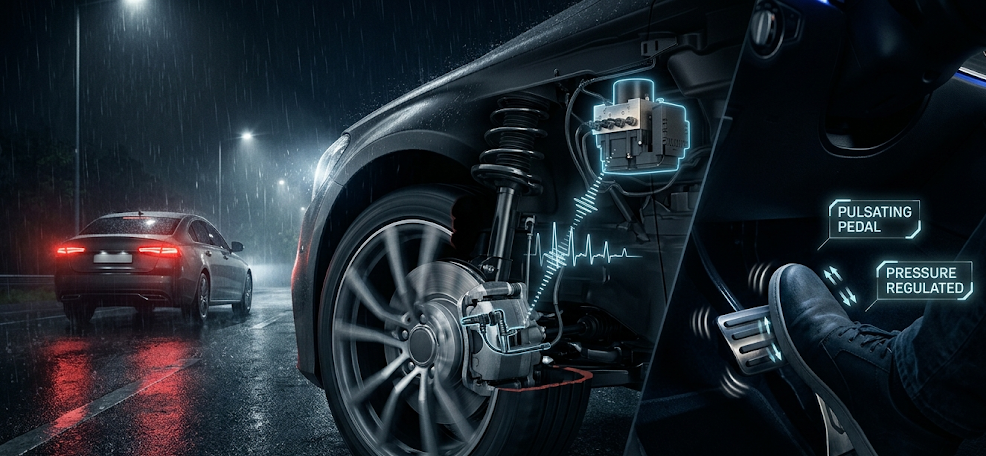
Instead of feeling a smooth pedal, you notice rapid vibrations beneath your foot. You may also hear clicking or buzzing sounds.
For drivers unfamiliar with anti-lock braking systems, these sensations can be surprising.
However, they often indicate that the vehicle’s ABS is working as intended.
ABS stands for Anti-lock Braking System. Its primary purpose is to prevent excessive wheel lockup during braking, helping the driver retain steering control.
Understanding how ABS works explains why the brake pedal pulses, how wheel-speed sensors contribute to safety, and why braking performance changes on different road surfaces.
What Happens When a Wheel Locks During Braking?
Under normal driving conditions, a tire rolls along the road while maintaining contact with the surface.
When the driver applies the brakes, the braking system creates resistance to wheel rotation.
If braking force becomes too great for the available tire-road grip, a wheel can stop rotating while the vehicle continues moving.
This condition is called wheel lockup.
A locked wheel slides across the road rather than rolling normally.
Sliding tires generally provide less predictable directional control than rolling tires operating near their optimum grip.
This can make it difficult for the driver to steer around an obstacle.
Wheel lockup may also increase stopping distance on many paved surfaces.
ABS is designed to reduce these problems by regulating brake pressure when a wheel approaches lockup.
How ABS Detects a Wheel About to Lock
Modern ABS systems monitor wheel rotation using wheel-speed sensors.
These sensors provide information about how quickly individual wheels are turning.
The electronic control unit compares wheel-speed signals and evaluates changes in rotational speed.
If a wheel slows much faster than expected during braking, the system may identify an approaching lockup condition.
The control unit then commands the hydraulic modulator to adjust brake pressure.
This process happens rapidly and repeatedly while ABS is active.
The exact control strategy depends on the vehicle’s design and the available sensor information.
ABS CONTROL PRINCIPLE
Detect Rapid Wheel Deceleration → Adjust Brake Pressure → Restore Controlled Rotation
The system repeats pressure adjustments as needed to reduce wheel lockup and preserve useful tire-road grip.
The Main Components of an ABS System
Although ABS designs vary, most modern systems rely on several essential components.
Wheel-Speed Sensors
Wheel-speed sensors monitor rotational movement at the wheels.
They help the control unit identify unusual deceleration patterns that may indicate an approaching lockup.
Electronic Control Unit
The electronic control unit processes sensor information and decides when brake pressure should be modified.
It uses programmed control logic to respond to changing wheel behavior.
Hydraulic Modulator
The hydraulic modulator contains valves that control pressure in the braking circuits.
Depending on the system, it can hold, reduce, or increase pressure to individual wheels or wheel groups.
Pump and Associated Hydraulic Components
Many ABS systems use a pump and other hydraulic components to help restore or manage pressure during repeated control cycles.
The combination allows rapid pressure adjustments without requiring the driver to manually release and reapply the brake pedal.
Why Does the Brake Pedal Pulse During ABS Operation?
The pulsing sensation comes from rapid changes in hydraulic brake pressure.
When ABS detects that a wheel is approaching lockup, the system may temporarily reduce pressure in the affected braking circuit.
It then holds or increases pressure as conditions change.
These adjustments can create vibrations that travel through the hydraulic system and are felt at the brake pedal.
Depending on the vehicle, the driver may notice a buzzing, clicking, or mechanical humming sound.
These sensations are usually normal during active ABS operation.
They do not automatically indicate brake failure.
However, unusual brake behavior outside ABS operation should be inspected by a qualified technician.
BRAKE PEDAL FEEDBACK / WHAT THE DRIVER FEELS
PRESSURE CONTROL
Reduce
The system releases some pressure when a wheel approaches lockup.
PRESSURE CONTROL
Hold
Pressure may be maintained while wheel behavior is evaluated.
PRESSURE CONTROL
Increase
Brake pressure rises again when more braking force can be applied.
These actions can occur repeatedly and rapidly. Their sequence and frequency vary with vehicle design and road conditions.
What Is Tire Slip and Why Does It Matter?
A tire does not need to be completely locked to experience slip.
During braking, the wheel may rotate slightly more slowly than it would during free rolling at the same vehicle speed.
This difference is called longitudinal slip.
A certain amount of slip is normal when a tire generates braking force.
However, excessive slip can reduce the tire’s ability to provide useful traction and directional control.
ABS attempts to prevent the wheel from entering a sustained locked condition.
It does not eliminate all slip.
The amount of slip associated with maximum braking force depends on the tire, road surface, and other conditions.
How ABS Helps Drivers Maintain Steering Control
One of the most important advantages of ABS is its contribution to steering control during hard braking.
A tire must generate lateral forces to help the vehicle change direction.
When a wheel is fully locked and sliding, its ability to respond predictably to steering input is reduced.
By allowing the wheels to continue rotating, ABS helps preserve some of the tire’s capacity to generate directional forces.
This can help the driver steer around an obstacle while braking.
However, ABS cannot overcome the physical limits of tire-road friction.
On a very slippery surface, available grip may remain extremely low.
ABS also cannot guarantee that a collision will be avoided.
Appropriate speed, safe following distance, and road awareness remain essential.
Does ABS Always Reduce Stopping Distance?
ABS often improves braking control and can reduce stopping distances on many paved surfaces.
However, it does not guarantee the shortest stopping distance under every condition.
On loose gravel or certain snow-covered surfaces, a locked wheel may push material ahead of the tire and create additional resistance.
Because ABS prevents sustained lockup, stopping distance can sometimes be longer on these surfaces than with locked-wheel braking.
The benefit of ABS is not limited to stopping distance.
Maintaining steering control and vehicle stability is a major part of its safety value.
Road conditions, tire design, vehicle load, and system calibration all influence performance.
How ABS Performs on Different Road Surfaces
| Road Surface | ABS Behavior | Important Consideration |
|---|---|---|
| Dry Pavement | Helps prevent wheel lockup during hard braking | Tire condition still affects grip |
| Wet Pavement | Adjusts pressure as traction becomes limited | Stopping distance may increase compared with dry roads |
| Ice | Attempts to maintain wheel rotation | Very low friction greatly limits braking ability |
| Loose Gravel | Reduces sustained wheel lockup | Stopping distance may be longer in some conditions |
| Snow | Controls slip according to wheel behavior | Performance varies with snow depth and surface conditions |
What Should You Do When ABS Activates?
In a vehicle equipped with functioning ABS, the usual emergency-braking guidance is to apply firm, continuous pressure to the brake pedal.
Do not repeatedly pump the pedal in an attempt to imitate ABS operation.
The system is designed to regulate hydraulic pressure automatically.
Keep your attention on the road and steer toward a safe path if necessary and possible.
Do not release the brakes simply because the pedal vibrates.
Always follow the instructions in your vehicle’s owner’s manual, particularly because braking systems and emergency-assistance features vary.
EMERGENCY BRAKING / DRIVER GUIDANCE
Press Firmly. Maintain Pressure. Steer as Needed.
For a properly functioning ABS-equipped vehicle, pedal pulsation during emergency braking is generally a sign that the system is regulating wheel slip.
ABS vs. Traditional Braking
Traditional hydraulic brakes rely on the driver to control braking force through pedal pressure.
Without ABS, excessive pressure can cause wheel lockup when tire-road grip is insufficient.
Experienced drivers may attempt threshold braking, applying strong pressure while trying to remain just below the point of lockup.
ABS performs rapid pressure adjustments automatically based on wheel behavior.
This can be especially valuable during unexpected emergencies when a driver has little time to react.
However, ABS does not replace the fundamental braking system.
Brake pads, discs or drums, hydraulic fluid, tires, and other mechanical components must still be maintained properly.
What Does the ABS Warning Light Mean?
Most modern vehicles have an ABS warning indicator on the dashboard.
The light commonly illuminates briefly when the vehicle starts as part of a system check.
If it remains on while driving, the vehicle may have detected a fault in the anti-lock braking system.
Depending on the vehicle and fault, conventional braking may still function, but anti-lock control may be unavailable.
A warning light should not be ignored.
Common fault areas include wheel-speed sensors, wiring, hydraulic components, and electronic control systems.
A qualified technician can inspect the vehicle and retrieve diagnostic information.
If the brake warning light also appears, or the pedal feels abnormal, the situation may require more urgent attention.
How ABS Works with Other Vehicle Safety Systems
ABS is closely related to several other electronic vehicle safety technologies.
Traction control systems can reduce excessive wheel spin during acceleration.
Electronic stability control systems help manage certain loss-of-control situations by selectively applying brakes and, in some cases, reducing engine power.
These systems often share wheel-speed sensors and other electronic components.
However, they perform different functions.
ABS primarily manages excessive wheel slip during braking.
Traction control focuses on wheel spin during acceleration.
Electronic stability control helps address certain vehicle stability problems.
All three depend on available tire-road grip and cannot eliminate the risks of excessive speed or poor road conditions.
Common Myths About ABS
AUTOMOTIVE SAFETY / MYTHS & FACTS
Myth: ABS always makes a vehicle stop faster.
Fact: Its stopping-distance benefits depend on the road surface and operating conditions.
Myth: A pulsing brake pedal means something is broken.
Fact: Pulsation during ABS activation is generally normal.
Myth: Drivers should pump the brakes when ABS activates.
Fact: In a functioning ABS-equipped vehicle, firm, continuous pedal pressure is generally recommended.
Myth: ABS prevents every skid.
Fact: ABS helps prevent braking-related wheel lockup but cannot overcome all traction limits.
Myth: ABS makes tire maintenance less important.
Fact: Tire condition remains critical because all braking systems depend on available grip.
Frequently Asked Questions
Why does my brake pedal vibrate during hard braking?
Rapid hydraulic pressure adjustments during ABS operation can create pedal pulsation and mechanical sounds.
Should I release the brake pedal when ABS activates?
Generally, no. In a properly functioning ABS-equipped vehicle, maintain firm pressure and follow the manufacturer’s emergency-braking guidance.
Does ABS work on ice?
ABS can operate on icy surfaces, but extremely low tire-road friction limits braking performance and steering control.
Can ABS increase stopping distance?
Yes. On some loose surfaces, such as gravel or certain snow conditions, stopping distances may be longer than with locked-wheel braking.
What happens if the ABS warning light stays on?
The system may have detected a fault. Have the vehicle inspected, as anti-lock braking functionality may be reduced or unavailable.
Is ABS the same as traction control?
No. ABS manages wheel slip during braking, while traction control primarily manages excessive wheel spin during acceleration.
Final Thoughts
Anti-lock braking systems help drivers maintain control when braking force approaches the limits of available tire-road grip.
Wheel-speed sensors detect changes in wheel rotation, while electronic controls and hydraulic components adjust braking pressure.
These rapid adjustments help prevent sustained wheel lockup.
The familiar pulsing sensation at the brake pedal is often a direct result of this pressure regulation.
ABS can improve steering control during emergency braking, but it cannot guarantee short stopping distances on every surface.
Safe driving still depends on suitable speed, good tires, proper maintenance, and adequate following distance.
Understanding ABS helps drivers recognize normal system behavior and respond more confidently when emergency braking becomes necessary.

Lead Automotive Research Engineer, Master ASE Certified Diagnostic Specialist, and powertrain dynamics consultant with over 18 years of experience in internal combustion thermodynamics, electric vehicle architectures, and chassis control systems.