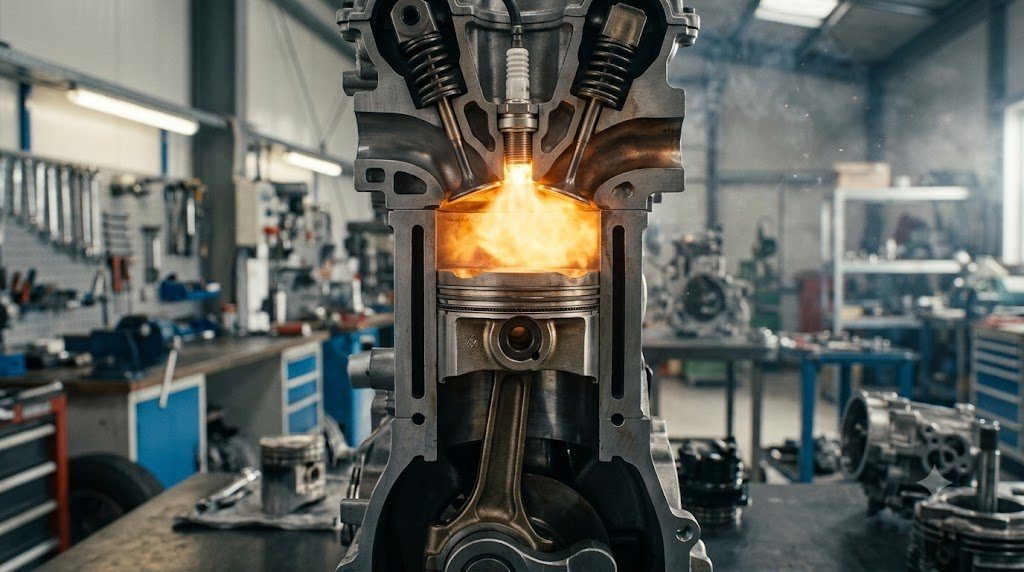
Welcome to AutoMechanics.online (accessible at https://automechanics.online/), an independent digital automotive engineering repository, technical research archive, and pedagogical open-access publication committed to excellence in internal combustion engines, advanced transmission geartrains, hydraulic and brake-by-wire braking systems, electric vehicle traction propulsion, and embedded vehicle electronics telemetry. Established to serve as a rigorous, mathematically sound bridge between academic automotive engineering research and frontline workshop diagnostic reality, AutoMechanics.online provides automotive engineers, master technicians, vocational instructors, and automotive scholars with comprehensive technical treatises, empirical formulations, and shop-proven diagnostic methodologies.
AutoMechanics.online was founded upon a core engineering conviction: that despite the rapid integration of artificial intelligence, automated driver-assistance systems (ADAS), and computerized scan tool diagnostics, the fundamental physical laws governing vehicle operation remain invariant. Whether analyzing thermodynamic gas cycles in reciprocating combustion chambers, planetary torque multiplication in multi-speed automatic transmissions, hydraulic pressure conservation in brake calipers, or electromagnetic vector control in AC traction motors, true diagnostic expertise requires understanding the underlying physics rather than merely clearing error codes.
Editorial Leadership & Automotive Authority
AutoMechanics.online is curated and led by Marcus Vance, a veteran Automotive Systems Research Engineer, Master ASE Certified Diagnostic Specialist, and powertrain dynamics consultant with over 18 years of continuous hands-on practice across engine dynamometer calibration, commercial transmission rebuilds, and high-voltage electric vehicle architectures. Having earned his Master of Science in Automotive Engineering with specialized research in transient turbocharger boost dynamics and direct-injection fuel spray atomization, Marcus has served as a senior technical consultant for tier-one powertrain suppliers, high-performance motorsport development teams, and advanced vehicle diagnostic tool manufacturers.
Under Marcus Vance’s editorial direction, every technical monograph, diagnostic flowchart, oscilloscope waveform analysis, and component specification table published on AutoMechanics.online undergoes exhaustive multi-tiered technical validation. Our editorial board cross-references all theoretical treatments against standardized international engineering benchmarks—principally the Society of Automotive Engineers (SAE International), the International Organization for Standardization (ISO), the German Institute for Standardization (DIN), and original equipment manufacturer (OEM) technical service bulletins (TSBs). We reject superficial summaries and generic overviews; our commitment is to provide actionable engineering depth that can be directly applied to vehicle design, chassis calibration, and complex workshop troubleshooting.
Core Research Domains & Vehicle Disciplines
Our open-access publication repository is structured across five primary branches of modern automotive engineering:
- Internal Combustion Engines: Comprehensive thermodynamic evaluations of Otto, Diesel, Atkinson, and Miller combustion cycles; kinematic analysis of reciprocating piston-rod-crank assemblies; cylinder head airflow dynamics, swirl, and tumble; forced induction turbocharger compressor maps and wastegate duty cycles; and high-pressure gasoline direct injection (GDI) fuel rails operating at pressures exceeding 250 to 350 bar.
- Transmissions and Drivetrains: Kinematic modeling of multi-speed planetary gear sets (Lepelletier, Simpson, and Ravigneaux arrangements), dual-clutch transmission (DCT) odd/even gear pre-selection, continuously variable transmission (CVT) push-belt traction tribology, lockup torque converter hydrodynamic fluid coupling, and electronic torque-vectoring limited-slip differentials.
- Braking Systems & Chassis Dynamics: Tribology of friction couples, brake pad material formulations (semi-metallic, low-metallic, and non-asbestos organic), rotor metallurgy and ventilated disc thermal dissipation modeling, brake-by-wire electro-hydraulic modulators, anti-lock braking algorithms (ABS), electronic brakeforce distribution (EBD), and regenerative deceleration torque blending.
- Electric Vehicle Propulsions: Lithium-ion cell electrochemistry (NMC, LFP, and solid-state), cell degradation mechanisms and dendrite formation, liquid-cooled battery thermal management systems (BTMS), permanent magnet synchronous motor (PMSM) versus AC induction motor dynamics, high-voltage silicon carbide (SiC) MOSFET inverter switching, and 800-volt DC fast charging architectures.
- Vehicle Electronics & Telemetry: Microcontroller architectures, deterministic Controller Area Network (CAN, CAN-FD) differential signaling, Local Interconnect Network (LIN), high-speed automotive Ethernet, FlexRay, sensor transduction physics (Hall effect, magneto-resistive, piezoresistive), and ISO 14229 Unified Diagnostic Services (UDS).
Pedagogical Methodology and First-Principles Diagnostic Philosophy
Modern automotive service is both an analytical science and a practical physical craft. When a vehicle exhibits an elusive drivability fault or intermittent electronic communication failure in the workshop, the root cause is rarely an inability to connect a scan tool; rather, it is almost invariably a failure to apply first-principles physical thinking: voltage drops across high-resistance ground terminals, unmetered air entering intake tracts through deteriorated vacuum seals, hydraulic fluid cavitation in worn transmission valve bodies, or parasitic capacitance distorting CAN bus differential square waves. Our monographs emphasize first-principles thinking:
- First-Principles Physical Derivations: Every fundamental equation—from brake swept area deceleration torque to electric motor back-EMF vectors—is derived with clear physical context so technicians and engineers understand underlying assumptions and boundary limits.
- Empirical Workshop Context: Production motor vehicles operate in harsh real-world environments characterized by road salt corrosion, extreme thermal swings (-40°C to +125°C under-hood), and violent mechanical vibrations. We integrate practical manufacturing tolerances, thread torque-to-yield specifications, surface roughness parameters, and electrical contact resistance considerations.
- Dynamic Failure Mode Diagnostics: We investigate real-world failure modes including carbon buildup on GDI intake valves, planetary clutch slippage, rotor thermal warping, lithium battery cell unbalance, and CAN bus arbitration collisions, offering prescriptive mitigation strategies.
Bridging Mechanical Powertrains with Modern Mechatronics
In contemporary vehicle architectures, pure mechanical hardware is completely intertwined with digital microcontrollers, smart actuators, and high-speed network protocols. An internal combustion engine cannot operate without real-time closed-loop wideband oxygen sensor feedback; an automatic transmission cannot shift gears without pulse-width-modulated (PWM) hydraulic pressure solenoids; and a modern braking system cannot safely halt a vehicle without electronic stability control (ESC) intervention.
At AutoMechanics.online, our research monographs specifically explore this electro-mechanical interface. We demonstrate how to diagnose electronic control units using digital storage oscilloscopes, how to interpret in-cylinder pressure transducer traces to identify restricted exhaust catalysts without physical disassembly, and how to verify high-voltage isolation integrity on electric vehicles safely. By uniting mechanical understanding with electronic diagnostic proficiency, we empower automotive practitioners to conquer modern vehicle complexity.
Institutional Commitments, Editorial Independence & Open Standards
AutoMechanics.online is maintained as an independent technical resource. We do not accept sponsored content, paid promotional vendor placements, or deceptive commercial tool endorsements. When diagnostic equipment, scan tools, or fluid lubricants are discussed, they are evaluated solely on their technical merit, engineering accuracy, and empirical field performance. Our operational costs are supported via transparent digital advertising networks, including Google AdSense, which are strictly segregated from our technical editorial decisions.
We welcome peer review, collaborative academic inquiries, and field data exchange from practicing engineers and master technicians worldwide. Automotive engineering thrives when ideas are tested, challenged, and refined through physical verification. Thank you for visiting AutoMechanics.online, and we invite you to explore our comprehensive library of automotive monographs.