EV MOTION & ENERGY LAB / AUTOMOTIVE ENGINEERING
Turning Motion Back Into Electricity
Discover how electric vehicles use their motors as generators, capture energy during deceleration, and reduce the energy wasted during everyday driving.
Every time a moving car slows down, some of its kinetic energy must go somewhere.
In a conventional gasoline-powered vehicle, much of that energy is converted into heat by the friction brakes.
The brake pads press against rotating discs or drums, creating friction that reduces the vehicle’s speed.
Electric vehicles can handle part of this process differently.
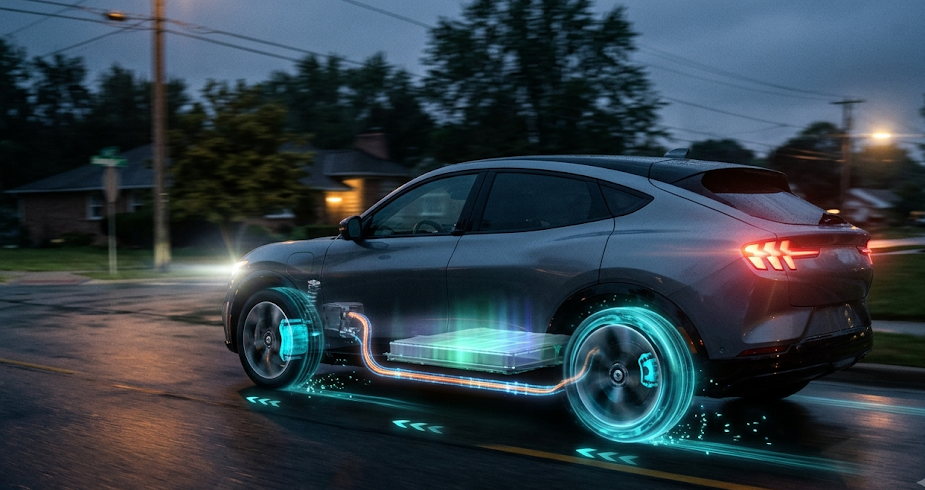
Instead of turning all the vehicle’s motion into heat, they can use their electric motors to generate electricity while slowing down.
This technology is called regenerative braking.
Regenerative braking converts some of a moving vehicle’s kinetic energy into electrical energy that can be stored in its battery.
It is one of the important technologies that help electric and hybrid vehicles use energy more efficiently.
However, regenerative braking does not recover all the energy used to accelerate a car, and it cannot replace conventional brakes in every situation.
Understanding how it works reveals the relationship between vehicle motion, electric motors, batteries, and braking systems.
What Is Regenerative Braking?
Regenerative braking is a method of slowing a vehicle while recovering some of its kinetic energy.
In an electric vehicle, the traction motor normally converts electrical energy from the battery into mechanical motion.
During regenerative braking, the energy flow reverses.
The vehicle’s moving wheels drive the motor, allowing it to operate as a generator.
The generated electricity is directed through the vehicle’s power electronics toward the battery, provided the battery can accept the energy.
This process creates resistance to wheel rotation, helping slow the vehicle.
Regenerative braking is also used in many hybrid vehicles and other electric transportation systems.
Its main advantage is that it recovers energy that would otherwise be dissipated as heat during braking.
The Science Behind Energy Recovery
A moving vehicle possesses kinetic energy.
The amount depends on the vehicle’s mass and speed.
The familiar equation for translational kinetic energy is:
PHYSICS NOTE / KINETIC ENERGY
E = ½mv²
Here, E represents kinetic energy, m is mass, and v is speed. Because speed is squared, a vehicle traveling twice as fast has four times the translational kinetic energy, assuming its mass stays the same.
When a driver slows down, the vehicle loses kinetic energy.
Traditional friction brakes convert much of that energy into heat.
Regenerative braking instead uses electromagnetic forces to convert part of the motion into electricity.
Some energy is still lost through electrical resistance, mechanical friction, and other processes.
Therefore, energy recovery is useful but never perfectly efficient.
How an Electric Motor Becomes a Generator
Electric motors and generators operate using closely related electromagnetic principles.
When an electric motor receives electrical power, electromagnetic forces produce torque that turns its shaft.
That torque can drive the vehicle’s wheels.
During regenerative braking, the wheels continue rotating because the vehicle is moving.
Through the drivetrain, this motion drives the electric machine.
The machine then converts mechanical energy into electrical energy.
Power electronics control the electrical currents and the braking torque.
The resulting generator torque opposes the vehicle’s motion, producing deceleration.
Modern electric vehicles can transition between propulsion and regeneration without requiring a separate mechanical generator.
The same traction motor often performs both functions.
The Regenerative Braking Process Step by Step
ENERGY FLOW / REGENERATIVE BRAKING
The car has kinetic energy because of its motion.
The driver releases the accelerator or presses the brake pedal, depending on the vehicle’s control system.
Wheel motion drives the electric machine, producing electrical energy and braking torque.
The battery stores some of the recovered energy for later use.
How Regenerative Braking Differs From Friction Braking
Conventional friction braking uses physical contact to slow a rotating wheel.
Brake pads press against discs, or brake shoes press against drums, converting motion into heat.
Regenerative braking creates braking torque through the electric drivetrain.
Instead of deliberately dissipating all the available energy, it converts part of that energy into electricity.
Both systems are important.
Friction brakes can provide strong stopping force when regenerative braking is limited or insufficient.
They are also essential for many emergency braking situations and for securely holding a stationary vehicle.
Most road-going electric vehicles therefore retain conventional friction brakes alongside regenerative braking.
Regenerative vs Conventional Braking
| Feature | Regenerative Braking | Friction Braking |
|---|---|---|
| Operating principle | Motor acts as a generator | Mechanical friction slows wheels |
| Energy conversion | Motion to electricity | Motion primarily to heat |
| Energy recovery | Partial recovery possible | Generally none |
| Brake wear | Can reduce friction-brake use | Pads and discs experience wear |
| Limitations | Depends on battery and motor conditions | Heat buildup and component wear |
How Much Energy Can Regenerative Braking Recover?
The amount of recovered energy varies considerably.
It depends on vehicle speed, mass, braking intensity, drivetrain efficiency, battery condition, and road conditions.
City driving often creates more opportunities for regeneration because vehicles frequently slow down and accelerate.
Highway driving at steady speed generally offers fewer braking events.
To illustrate the available energy, consider a vehicle with a mass of 1,800 kilograms traveling at 60 kilometers per hour.
That speed is approximately 16.7 meters per second.
Using the kinetic energy equation, its translational kinetic energy is approximately 250,000 joules, or 0.069 kilowatt-hours.
This represents the energy associated with its forward motion at that speed, excluding rotational energy.
Only a portion could be recovered during braking.
Losses occur in the motor, power electronics, battery, and mechanical systems.
Additional energy may also be dissipated through friction braking.
Regeneration therefore reduces energy consumption, but it cannot make driving energy-free.
Why Regenerative Braking Works Well in City Driving
Urban driving often involves repeated acceleration and deceleration.
Traffic lights, intersections, pedestrian crossings, and congestion create frequent opportunities to slow down.
Without regenerative braking, much of the kinetic energy gained during acceleration would be lost as heat during braking.
With regeneration, some of that energy returns to the battery.
The recovered electricity can later help power the motor.
This can improve overall energy efficiency, particularly in stop-and-go conditions.
However, the benefit depends on driving style, traffic conditions, and the vehicle’s regenerative braking capability.
Smooth driving that avoids unnecessary acceleration and braking can also help reduce energy use.
What Is One-Pedal Driving?
Some electric vehicles offer a feature commonly called one-pedal driving.
In this mode, releasing the accelerator pedal can produce substantial regenerative deceleration.
The driver can control much of the vehicle’s acceleration and slowing through a single pedal.
Depending on the vehicle, the system may even bring the car to a complete stop.
However, one-pedal driving does not eliminate the brake pedal.
The driver must still use the friction braking system when additional stopping force is required.
The strength and behavior of one-pedal driving vary between manufacturers and models.
Drivers should become familiar with their vehicle’s controls before relying on the feature.
What Is Blended Braking?
Many electric and hybrid vehicles use blended braking systems.
These systems coordinate regenerative braking with conventional friction braking.
When the driver presses the brake pedal, the vehicle may initially request regenerative braking.
If more stopping force is needed, friction brakes provide additional braking torque.
The balance can change continuously depending on speed, battery condition, traction, and driver demand.
The goal is to recover energy where practical while delivering predictable and safe braking performance.
Blended braking requires careful engineering because drivers expect the brake pedal to respond consistently.
Why Regenerative Braking Becomes Limited Near a Full Battery
Regenerative braking depends on the battery’s ability to accept electrical energy.
When the battery is nearly full, there may be less available charging capacity.
The battery management system may therefore restrict the amount of regenerative power.
This protects the cells from exceeding their permitted operating limits.
Some vehicles reduce regenerative braking noticeably at high states of charge.
Others use additional control strategies to maintain a more consistent driving feel.
Cold battery temperatures can also reduce the available regenerative braking power.
For this reason, drivers may notice changes in deceleration behavior depending on battery charge and temperature.
Does Regenerative Braking Work at Very Low Speeds?
Regenerative braking capability often decreases at very low vehicle speeds.
The amount of available mechanical power becomes smaller as speed decreases for a given braking torque.
Motor characteristics and control strategies also influence low-speed regeneration.
Some electric vehicles use friction brakes to complete the final part of a stop.
Others coordinate motor torque and braking controls to provide a smooth stopping experience.
The exact behavior depends on the vehicle’s design.
This is another reason conventional friction brakes remain essential even in vehicles with strong regenerative braking systems.
How Road Conditions Affect Energy Recovery
Regenerative braking creates braking force through the driven wheels.
Like other braking forces, it is limited by the available tire-road grip.
On slippery roads, excessive braking torque could cause wheel slip.
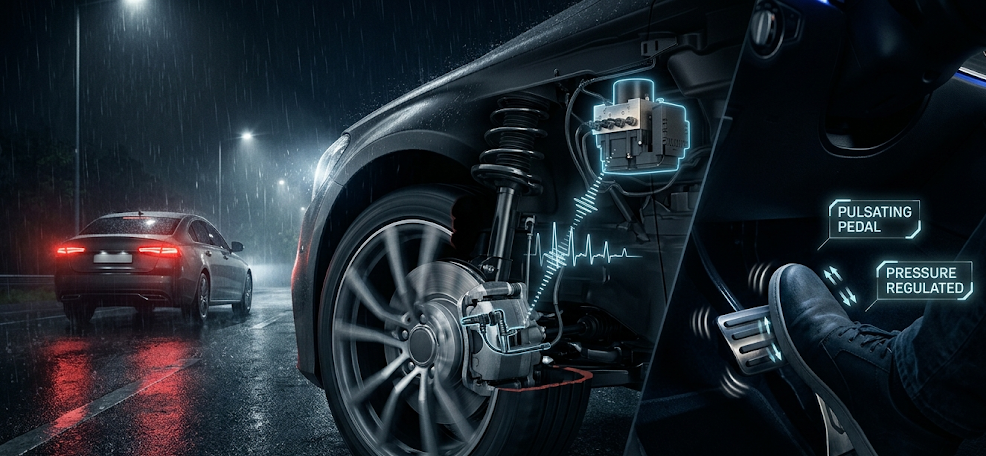
Vehicle stability and anti-lock braking systems may therefore reduce or modify regenerative braking.
Wet pavement, ice, snow, and loose surfaces can all affect available traction.
Safety systems take priority over maximizing energy recovery.
Drivers should not assume that regenerative braking alone provides sufficient control in difficult conditions.
Can Regenerative Braking Reduce Brake Wear?
Yes. Because regenerative braking can provide some of the vehicle’s deceleration, the friction brakes may be used less frequently.
This can reduce wear on brake pads and discs.
However, reduced use does not mean the friction braking system requires no maintenance.
Brake components can still experience corrosion, contamination, and age-related deterioration.
Regular inspection remains important.
Maintenance recommendations vary by vehicle and should follow the manufacturer’s schedule.
Regenerative Braking in Hybrid Vehicles
Hybrid vehicles also use regenerative braking to recover energy.
During deceleration, an electric motor-generator can convert mechanical energy into electricity.
The recovered energy is stored in the hybrid battery.
That energy may later help propel the vehicle or support electrical systems.
Because hybrid batteries are generally smaller than those in fully electric vehicles, their energy acceptance limits and control strategies may differ.
Nevertheless, the underlying principle is similar: recover some kinetic energy instead of wasting it entirely as heat.
Common Misunderstandings About Regenerative Braking
One misconception is that regenerative braking can recover all the energy used to accelerate a vehicle.
In reality, energy losses occur during both acceleration and regeneration.
Another misconception is that regenerative braking completely replaces conventional brakes.
Friction brakes remain necessary for reliable stopping under many conditions.
Some people also assume that stronger regenerative braking always produces better efficiency.
However, avoiding unnecessary braking can be more efficient than repeatedly accelerating and recovering only part of the energy.
Finally, regenerative braking does not generate electricity from nothing.
It converts energy that the moving vehicle already possesses.
Frequently Asked Questions
What is regenerative braking in an electric car?
It is a braking method that uses the electric motor as a generator to recover some of the vehicle’s kinetic energy and return it to the battery.
Does regenerative braking charge the battery?
Yes. It can return electrical energy to the battery during deceleration when operating conditions allow.
Can regenerative braking stop a car completely?
Some vehicles can come to a complete stop using one-pedal driving controls, but friction brakes remain essential for additional stopping force and other situations.
Does regenerative braking work when the battery is full?
It may be reduced or unavailable when the battery is near full because the battery cannot accept unlimited charging energy.
Is regenerative braking better in city driving?
It is often particularly beneficial in stop-and-go traffic because frequent deceleration creates more opportunities to recover energy.
Does regenerative braking reduce brake pad wear?
It can reduce friction-brake use and wear, but regular brake inspection and maintenance are still necessary.
Do hybrid cars use regenerative braking?
Yes. Many hybrid vehicles use motor-generators to recover energy during braking and store it in their batteries.
Final Thoughts
Regenerative braking is an important example of how electric vehicles manage energy differently from conventional cars.
Instead of converting all braking energy into heat, an electric vehicle can use its traction motor as a generator.
This allows some kinetic energy to return to the battery for later use.
The technology can improve efficiency, particularly during driving that involves frequent slowing and acceleration.
It may also reduce wear on conventional friction brakes.
However, regenerative braking has limits.
Battery charge level, temperature, vehicle speed, and available traction all affect how much energy can be recovered.
Modern electric vehicles therefore combine regeneration with conventional braking systems to balance energy efficiency and safe stopping performance.
The next time an electric car slows down, remember that some of its motion may be returning to the battery as useful electrical energy.

Lead Automotive Research Engineer, Master ASE Certified Diagnostic Specialist, and powertrain dynamics consultant with over 18 years of experience in internal combustion thermodynamics, electric vehicle architectures, and chassis control systems.