AUTOMOTIVE ENGINEERING / ENGINE COMPONENTS EXPLAINED
Two Ways to Keep an Engine Running in Perfect Time
Understand how timing belts and timing chains synchronize engine components, why manufacturers choose different designs, and what drivers should know about maintenance.
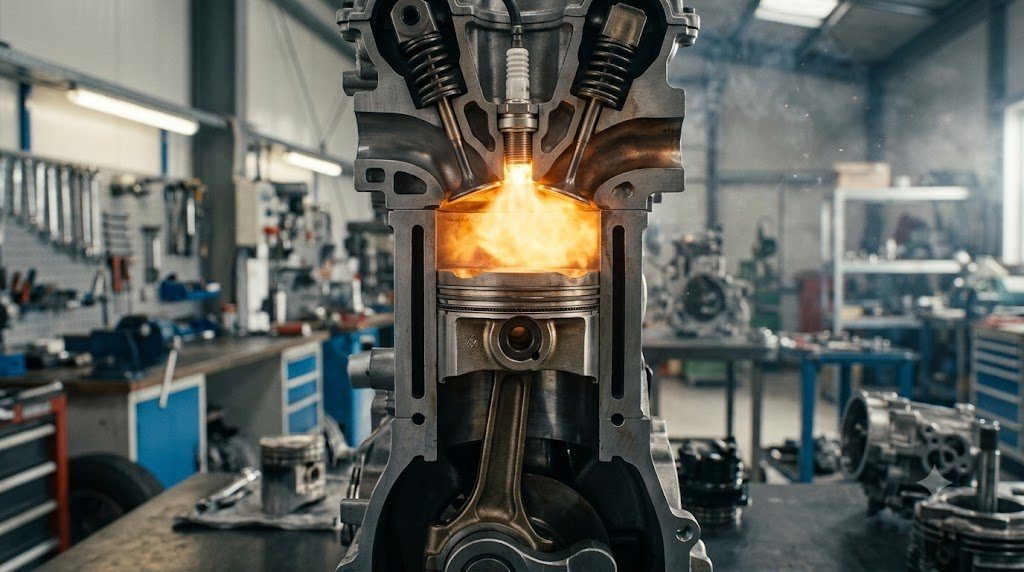
Every modern four-stroke gasoline or diesel engine depends on precise mechanical timing. Pistons move up and down inside cylinders while intake and exhaust valves open and close at carefully controlled moments.
For the engine to operate correctly, these movements must remain synchronized. A timing belt or timing chain provides the mechanical connection that makes this possible in many automotive engines.
Although both components perform essentially the same fundamental job, they differ in construction, maintenance requirements, noise characteristics, and potential repair costs.
For vehicle owners, the distinction matters because a neglected timing system can eventually lead to serious engine damage.
Understanding the differences between timing belts and timing chains can help you follow the correct maintenance schedule and recognize when professional inspection is necessary.
What Does an Engine Timing System Do?
Inside a four-stroke engine, the crankshaft converts the pistons’ reciprocating motion into rotation. The camshaft controls the opening and closing of the engine’s valves.
These components must rotate in a specific relationship. In a conventional four-stroke engine, the camshaft rotates once for every two revolutions of the crankshaft.
The timing belt or chain connects the crankshaft to one or more camshafts, maintaining the required relationship between piston movement and valve operation.
If the timing system becomes excessively worn, slips, or fails, the engine may run poorly or stop altogether.
Some engines are designed with additional gears or intermediate components, but the central purpose remains the same: keeping valve timing synchronized with crankshaft rotation.
ENGINEERING PRINCIPLE / VALVE TIMING
The Crankshaft and Camshaft Must Stay Synchronized.
A timing belt or chain maintains their mechanical relationship so the valves operate at the intended points in the engine cycle.
What Is a Timing Belt?
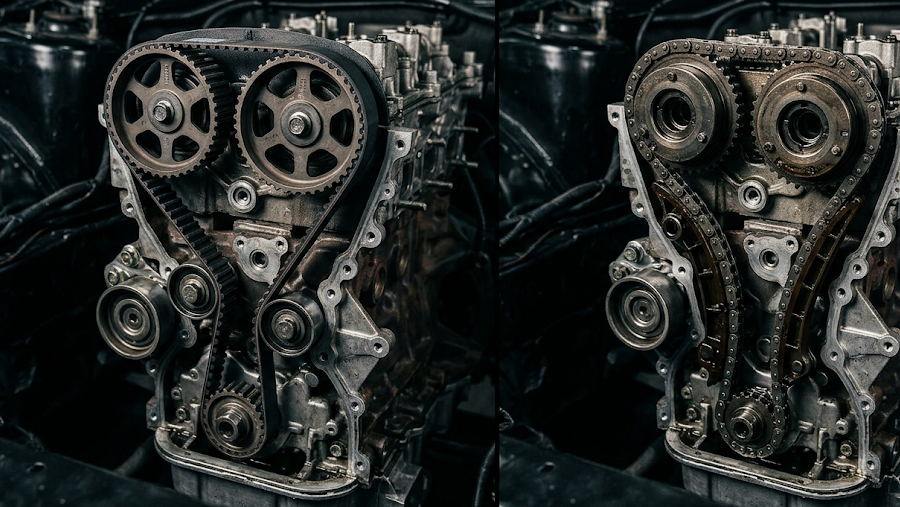
A timing belt is a reinforced flexible belt with molded teeth that engage matching toothed pulleys. The teeth prevent the belt from slipping during normal operation and help maintain accurate timing.
Timing belts are commonly made from durable synthetic rubber compounds reinforced with strong fibers. The exact materials vary between manufacturers and engine applications.
Many timing belts operate behind protective covers, separate from the engine’s lubricating oil. Some newer engines use wet timing belts designed to operate in oil, which introduces different maintenance considerations.
Timing belts are generally lighter and quieter than traditional metal chain systems. Their flexible construction can also help reduce mechanical noise.
However, belt materials deteriorate over time and through repeated use. For engines with scheduled belt replacement, manufacturers specify maintenance intervals based on mileage, age, or both.
What Is a Timing Chain?
A timing chain performs the same synchronization function using interconnected metal links rather than a reinforced rubber belt.
Timing chains operate around sprockets connected to the crankshaft and camshaft. Most automotive timing chains are lubricated by engine oil.
Chain systems commonly include guides and tensioners that help control chain movement and maintain appropriate tension.
Metal construction gives timing chains excellent potential durability, and many engines do not have a routine chain replacement interval under normal operating conditions.
Nevertheless, timing chains are not maintenance-free. Chains can wear or elongate, tensioners may malfunction, and guides can deteriorate.
Because timing chains often operate inside the engine, repairs may require substantial disassembly, increasing labor costs.
TIMING SYSTEM 01
Timing Belt
A reinforced toothed belt that is often quieter and typically requires replacement at manufacturer-specified intervals.
TIMING SYSTEM 02
Timing Chain
A metal chain that is often designed for long service life but depends on proper lubrication and functioning tensioners.
Timing Belt vs Timing Chain: Main Differences
The biggest differences involve materials, service intervals, lubrication, and repair complexity.
Timing belts are commonly replaced as preventive maintenance. Timing chains may last considerably longer, although specific engines can experience chain-related problems.
Neither system is automatically superior in every application. Engineers consider engine layout, packaging, noise, manufacturing costs, friction, and long-term reliability when choosing a design.
| Feature | Timing Belt | Timing Chain |
|---|---|---|
| Construction | Reinforced flexible belt | Metal links |
| Typical Noise | Often quieter | May produce more mechanical noise |
| Lubrication | Usually dry; some designs run in oil | Usually engine-oil lubricated |
| Replacement | Often scheduled | Frequently condition-based |
| Common Concerns | Aging, tooth damage, tension issues | Wear, guides, tensioners, lubrication |
| Repair Complexity | Varies by engine layout | Can require extensive disassembly |
How Long Does a Timing Belt Last?
Timing belt replacement intervals vary widely between vehicle manufacturers and engine designs.
Some engines specify replacement around 60,000 miles, while others allow substantially longer intervals, sometimes exceeding 100,000 miles.
Time-based replacement limits may also apply, even when a vehicle has relatively low mileage.
These figures should never replace the schedule published for your exact engine.
Heat, contamination, incorrect tension, and component defects can affect belt durability. On wet-belt engines, oil condition and the correct lubricant specification may be especially important.
When replacing a belt, technicians may also recommend servicing related tensioners, idler pulleys, or water pumps when those components are driven by the timing belt.
How Long Does a Timing Chain Last?
Timing chains are often designed to operate for much of an engine’s service life. However, that does not mean every timing chain will last indefinitely.
Actual durability depends on chain design, lubrication quality, engine operating conditions, and the reliability of supporting components.
Some engines have known timing chain or tensioner problems that may require attention earlier than expected.
Regular oil changes using the manufacturer-specified oil grade and specification help protect lubricated timing components.
If unusual timing-related noises or diagnostic trouble codes appear, the system should be inspected rather than assuming that a chain never needs service.
What Happens If the Timing System Fails?
A timing belt can break or lose teeth. A timing chain can jump timing or fail because of severe wear or problems with its tensioning system.
When synchronization is lost, the camshaft may no longer operate the valves at the correct points in the piston cycle.
The consequences depend heavily on engine design.
In an interference engine, the valves and pistons occupy overlapping areas of the combustion chamber at different moments. Correct timing prevents them from colliding.
If timing is lost, piston-to-valve contact can occur, potentially bending valves or causing other internal damage.
In a non-interference engine, a timing failure may stop the engine without causing the same type of contact, although other damage is still possible.
IMPORTANT / ENGINE DAMAGE RISK
A Failed Timing System Can Cause Major Damage in an Interference Engine.
If the engine suddenly stops and a timing failure is suspected, avoid repeated starting attempts. Have the vehicle inspected by a qualified technician.
Warning Signs of Timing System Problems
Timing belt and chain problems do not always produce obvious warnings before failure. However, certain symptoms may indicate that the system requires inspection.
Possible warning signs include unusual rattling or mechanical noises, rough engine operation, misfires, reduced performance, and illuminated check-engine warnings.
Chain-related rattling during startup can sometimes be associated with tensioner or lubrication problems, although other engine components may produce similar sounds.
Timing-related diagnostic trouble codes may indicate a mismatch between crankshaft and camshaft positions.
These symptoms are not proof of a failed timing belt or chain. Accurate diagnosis requires appropriate inspection and testing.
For engines with scheduled timing belt replacement, waiting for symptoms is particularly risky because deterioration may not be noticeable during ordinary driving.
Timing Belt vs Timing Chain Replacement Costs
Repair costs vary significantly depending on vehicle make, engine design, labor rates, and the parts that must be replaced.
Timing belt service can be labor-intensive because technicians may need to remove engine covers, accessory components, and other parts to access the belt.
Some timing chain repairs are even more complex, particularly when the chain is located deep inside the engine or toward the transmission side.
Replacing tensioners, guides, seals, or related components can increase the total cost.
Rather than relying on a universal price estimate, request a vehicle-specific written quote that identifies the included parts and labor.
Preventive maintenance is generally preferable to repairing extensive internal engine damage after a timing system failure.
How to Find Out Which System Your Car Uses
Not every vehicle model uses the same timing system across all engine options or model years.
The most reliable approach is to check the owner’s manual, manufacturer service information, or a trustworthy parts reference matched to your vehicle’s exact engine.
A qualified mechanic can also identify the system using the vehicle identification number and engine specifications.
Do not assume that all vehicles from a particular brand use belts or chains. Manufacturers may use both designs across their product ranges.
When buying a used vehicle, ask for documented timing belt replacement history if the engine requires scheduled service.
Which Design Is Better for Long-Term Ownership?
A timing chain may be appealing because many chain-driven engines do not require routine replacement at fixed mileage intervals.
However, a chain system that develops problems can be expensive to repair.
A timing belt requires more predictable preventive maintenance, but its service needs may be clearly documented in the manufacturer’s schedule.
For long-term ownership, the overall reliability of the engine matters more than whether it uses a belt or chain.
Maintenance history, oil quality, known engine-specific issues, and repair accessibility all influence ownership costs.
It is therefore better to evaluate the exact engine than to judge a vehicle solely by its timing system.
Frequently Asked Questions
Is a timing chain better than a timing belt?
A timing chain often offers longer service life, but neither design is automatically better. Reliability depends on the specific engine and maintenance history.
Does a timing belt need regular replacement?
Many timing belt engines have manufacturer-specified replacement intervals based on mileage, age, or both.
Can a timing chain last the life of an engine?
Some do, but chains, guides, and tensioners can wear or fail. Proper maintenance remains important.
What happens if a timing belt breaks?
The engine will usually stop running. In an interference engine, internal damage may occur if pistons contact open valves.
Do timing chains need oil?
Most automotive timing chains operate with engine-oil lubrication, making correct oil maintenance important.
Is timing belt replacement expensive?
Costs vary by vehicle and engine layout. The service can involve substantial labor and replacement of related components.
How do I know whether my car has a timing belt or chain?
Check manufacturer service information for your exact engine or ask a qualified technician to identify the system.
Final Thoughts
Timing belts and timing chains perform the same essential task: keeping the crankshaft and camshaft synchronized so an engine’s valves operate at the correct moments.
Timing belts use reinforced flexible materials and often require scheduled replacement. Timing chains use metal links and may operate for much longer periods, although their supporting components can still wear.
Both systems can cause serious problems if they fail, particularly in interference engines.
For vehicle owners, the most important decision is not choosing one technology over the other. It is understanding which system the vehicle uses and following the appropriate maintenance recommendations.
Regular servicing, attention to unusual symptoms, and accurate repair records can help protect engine reliability and reduce the risk of unexpected repairs.

Lead Automotive Research Engineer, Master ASE Certified Diagnostic Specialist, and powertrain dynamics consultant with over 18 years of experience in internal combustion thermodynamics, electric vehicle architectures, and chassis control systems.